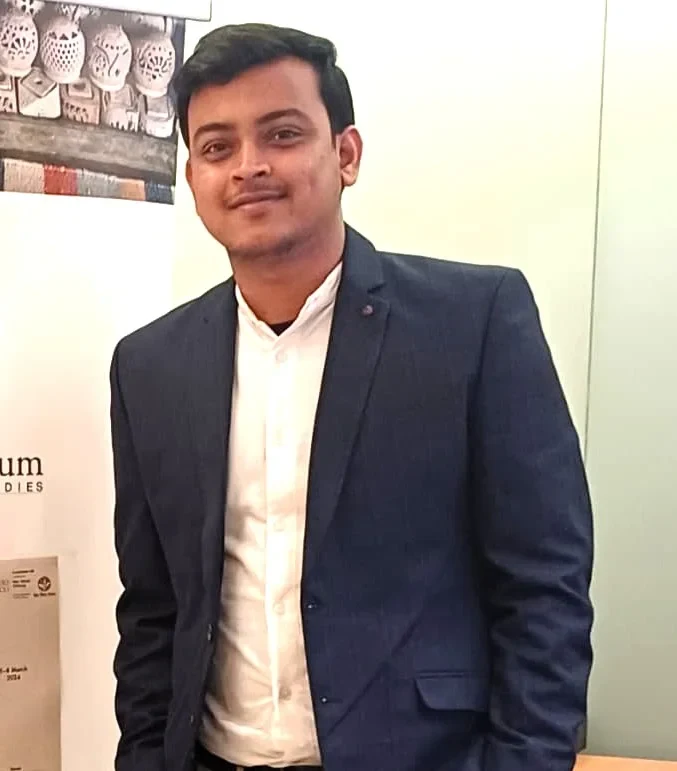
Ankit Chowdhury
Predoctoral Fellow
Bonn Center for Dependency and Slavery Studies
Room 2.004
Niebuhrstraße 5
D-53113 Bonn
achowdhu@uni-bonn.de
Project: "Conscripted Water: Riverine Systems and Asymmetrical Dependency in Industrial India"
Academic Profile
Conscripted Water: Riverine Systems and Asymmetrical Dependency in Industrial India
The project examine how post-liberalization industrialization in India, generates strong asymmetrical dependency relations through the entanglement of labour, infrastructure and ecology. The study therefore, asks how the juridical abandonment of industrial-riverine channels exposes communities to ecological vulnerability and reproduce co-determining SAD relations among different positionalities. The research then, analyzes two Indian steel towns - Durgapur and Rourkela which were established as a flagship public sector projects shaped by cold-war era collaboration between India, United Kingdom and West Germany in 1959. Ultimately, the project aims to contribute to debates on post-colonial nation building, and political ecology. Mainly by demonstrating that dependency relations can be reproduced through juridical amnesia and absence rather than direct coercion and it introduces the ungoverned industrial-riverine channels as an underexamined site where labour immobility and ecological exposure are co-produced and mutually reinforcing.
2022–2025
MA in Dependency and Slavery Studies, University of Bonn, German
2018–2021
BA in History, Scottish Church College (affiliated to the University of Calcutta), India
- 2023. "Breaking the Silence: Uncovering the Voices of Indian Indenture Labourers in Trinidad & Tobago and British Guyana." Journal for People's History and Culture 9(1): 121–130.
- 2023. With Sofia Buitrago. "Competing Memories: The Politics of Remembering Enslavement, Emancipation, and Indentureship in the Caribbean." Dependent (Magazine of the Bonn Centre for Dependency and Slavery Studies) 7: 85–87.
- 2024. "Whose Global History? Reflections on the 'Writing India into Global History' Workshop at MWF-Delhi." Dependency Blog (BCDSS).