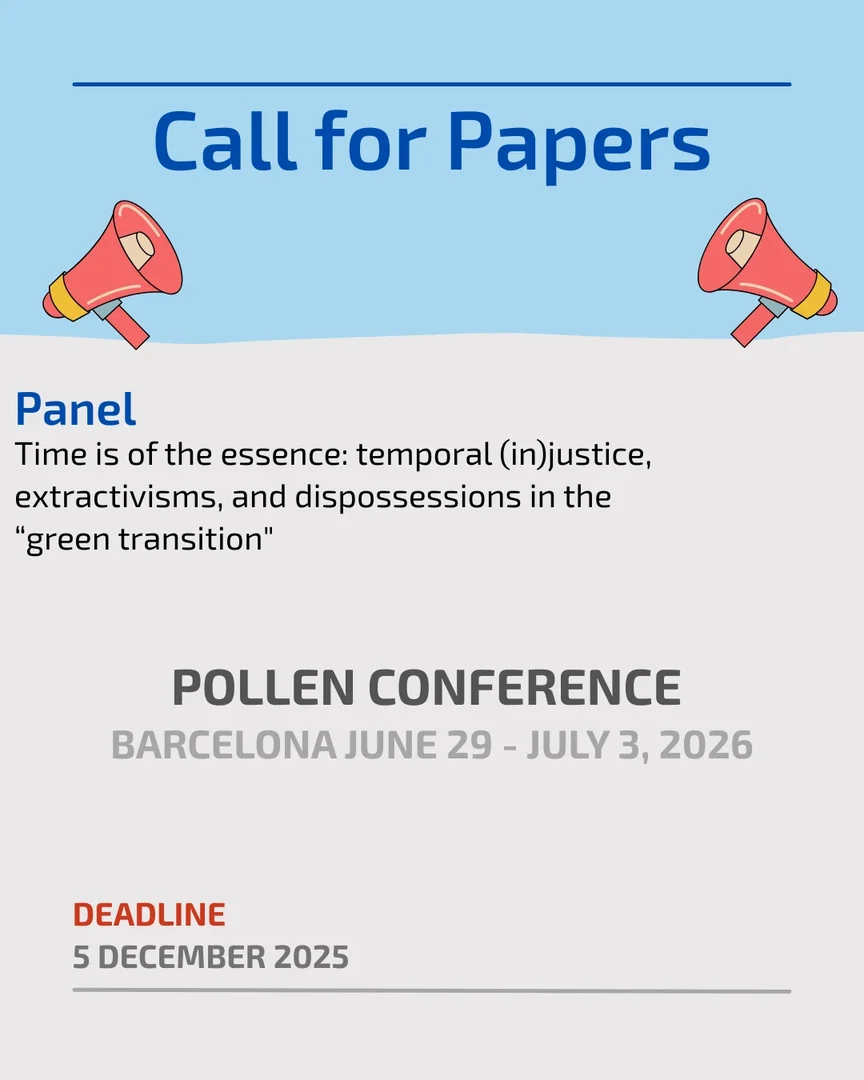
This panel invites contributions that interrogate how time, in its various forms and rhythms, becomes a site of contestation in extractive development and green transitions. Key points include:
- Extractive industries and renewable energy infrastructures often impose urgent, accelerated temporalities (e.g., rapid planning, fast resource exploitation) in order to meet global demands for raw materials.
- In contrast, Indigenous, rural and other local communities often operate with slower, cyclic, intergenerational temporalities, seasonal practices, long-term land relations, embodied histories.
- These differing temporal regimes clash when large-scale extraction or green-transition projects encroach on territories that were previously structured by different rhythms. The panel asks: Can time itself be a medium of (in)justice, of conflict or repair? How do temporal frictions shape resistance and future imaginaries?
- Contributions are welcome from a range of fields: political ecology, human geography, critical heritage studies, legal studies, etc.
Format & Publication
The panel will select 5 to 8 papers for oral presentation.
The convenors intend to organise and publish a special issue in a journal based on the contributions to the panel.
Important Deadlines & Participation Details
-The full conference (POLLEN 2026) will take place in Barcelona from 29 June to 3 July 2026.
-For this panel (and others), the deadline for submitting paper proposals is Friday 5 December 2025 at 23:59 CET.
-Panel convenors will make decisions about accepted contributions by 19 December 2025.
If your research engages with land, resources, dispossession, temporalities of development or transition, this panel offers an opportunity to place your work alongside others asking how time, rhythm, urgency and futures are negotiated in socio-ecological transformations.
The special-issue publication intention means that presenting here could lead to peer-reviewed output.
The conference in Barcelona provides an international forum and networking venue to connect with scholars of political ecology, critical development studies, heritage and resource governance.