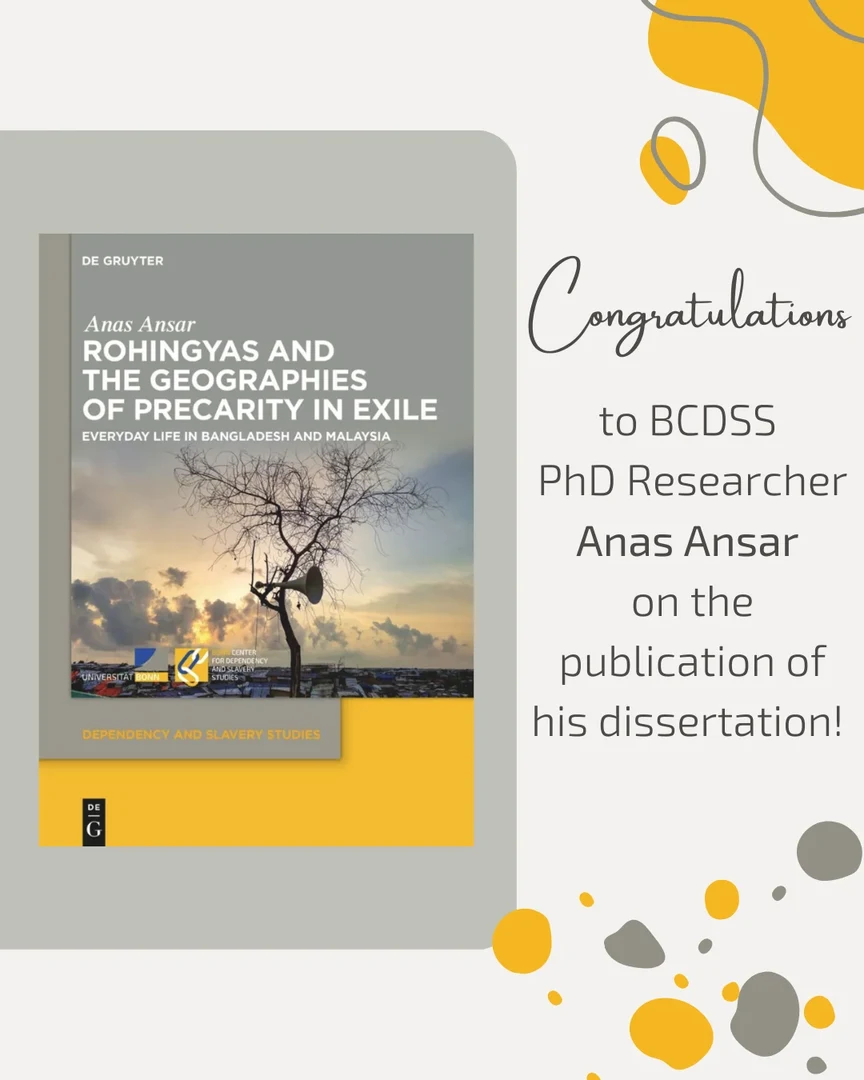
Anas Ansar's dissertation on Rohingyas and the Geographies of Precarity in Exile: Everyday Life in Bangladesh and Malaysia has just been published in our Dependency and Slavery Studies (DSS) series with De Gruyter.
About the book:
Focusing on Myanmar's Rohingya refugees in Bangladesh and Malaysia, this study provides an in-depth analysis of the contribution of historical legacies of exclusion, along with contemporary practices of marginalisation and otherisation to the transcendence of the precarity landscape. In light of the 2017 displacement of over a million Rohingya from Myanmar's Rakhine state to neighbouring Bangladesh, the book offers a nuanced and empirically driven analysis of precarity across a wide spectrum at discrete and overlapping scales, shaped by statelessness, vulnerability, uncertainty, onward migration and everyday practices of exclusion. Bringing together the diverse manifestation along the lines of identity, status, space, mobility, gender and labour, the study proposes a comprehensive understanding of precarity, conceptualised as the 'interconnected geographies of precarity'. Elucidating the intricate web of structural constraints that predate (in Myanmar) and are continually reconstructed and actualised (in exile), the book examines the continuum of precarity in extended transnational spaces – a phenomenon that is complex, non-linear, transitional and multi-faceted.
Anas Ansar on his dissertation:
This study adds to the emerging literature on everyday life practices in the context of forced migration and protracted refugee situations. Focusing on the case of Myanmar's Rohingya refugees in Bangladesh and Malaysia, this study offers an in-depth analysis of how historical legacies of exclusion, along with contemporary practices of marginalisation and otherisation contribute to transcending the spectrum of precarity. Although violence, persecution and forced displacement have been recurring phenomena in the lives of the Rohingyas since at least the 1970s, the situation turned into a major humanitarian crisis in August 2017, with nearly a million Rohingyas fleeing from Myanmar into neighbouring Bangladesh. Over the years, with no solution in sight, their plight in exile has turned into a protracted crisis, with diverse actors, policies and arbitrary governance practices producing and expanding the conditions of precarity.
Documenting the contextual interplay of change and continuity, the findings chronicle a nuanced and empirically driven analysis of how precarity is experienced across a wider spectrum at discrete and overlapping scales and shaped by statelessness, vulnerability, politics of uncertainty, onward migration and everyday practices of exclusion. They also underline the multi-layered dependency and spontaneity ingrained in their everyday lives. Bringing together the diverse manifestation of precarity along the lines of identity, status, space, mobility, gender and labour, the study proposes a comprehensive understanding of precarity, conceptualised as the "interconnected spectrum of precarity". Framing precarity as a process and capturing their intersectional vulnerabilities and constrained expressions of agency shaped across time and space, the findings argue that the manifestation of precarity in Rohingya’s lives is far more complex, non-linear, transitional, and multi-faceted. Elucidating the intricate web of structural constraints that both predate (in Myanmar) and are continually reconstructed and actualised (in exile), this research underlines how the continuum of precarity manifests itself in the extended transnational spaces. In cataloguing these multifaceted and multi-sited experiences, another key goal of this study is also to offer a nuanced reflection of some of the negotiated practices of survival and coping mechanisms across different places. It captures the spatially and temporally distributed (and disrupted) social space of displaced people and the pursuit of belonging through clandestine citizenship practices. Doing so presents how space of exception and the acts of resilience figure in and collide with everyday life practices at various junctures.
By integrating diverse perspectives, the study sheds light on an inclusive understanding of precarity, arguing that the wider spectrum of precarity, including that of labour, needs to be reoriented from the practices and constellations of borderland dynamics, otherisation, and exclusion that vividly shapes their limits of belonging.