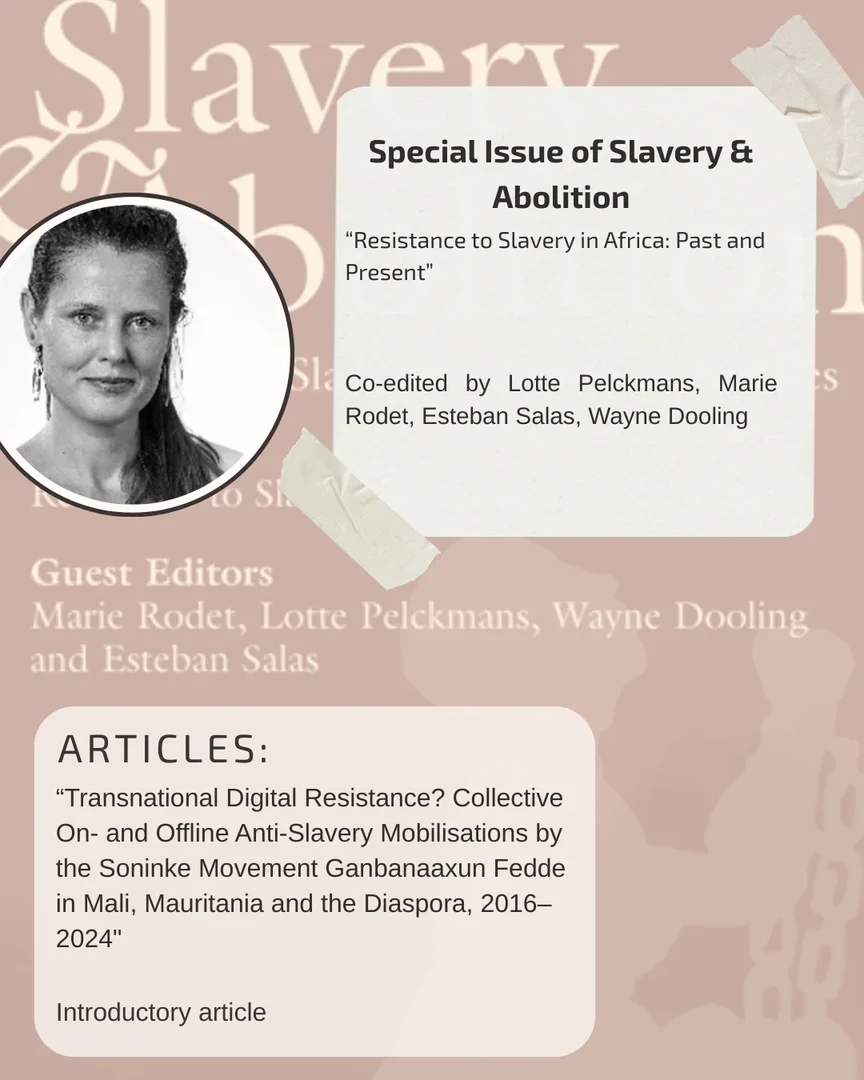
In the special issue “Resistance to Slavery in Africa: Past and Present”, Lotte Pelckmans and her co-editors Marie Rodet, Esteban Salas, and Wayne Dooling, have brought together innovative research that explores how resistance to slavery has been expressed, remembered, and studied across Africa—both in historical and contemporary contexts.
The issue offers a pan-African perspective on the diverse forms of resistance to slavery across time and space. In addition to the pioneer scholarship on Atlantic transformations in African societies, it examines resistance in West, Central, West Central, East and Southern Africa, including responses to the trans-Saharan and Indian Ocean slave trades, local slavery systems and their post-abolition legacies. A central contribution is its integration of Anglophone, Francophone, Lusophone, Arabic and Ottoman scholarships, bridging historiographical divides. Furthermore, the issue foregrounds the role of resistance within customary, Islamic and colonial legal frameworks, showing how enslaved people asserted rights, claimed freedoms or mitigated exploitation. Gendered resistance is also a key focus, highlighting how women fled sexual violence, defended kinship ties and built new communities. Methodologically, the collection employs an interdisciplinary approach, from oral history, microhistory, social history to digital humanities, to recover subaltern voices and reinterpret archival silences. It challenges linear narratives of abolition by revealing resistance as a struggle not only for formal emancipation but also for reshaping social relations and asserting relative autonomy within oppressive systems. Finally, a distinctive feature is the inclusion of contemporary resistance, such as grassroots anti-slavery activism using digital platforms like WhatsApp mobilize marginalized communities. Overall, by linking historical and present-day struggles, the volume underscores that resistance to slavery is a continuous and evolving process. Together the contributions reframe African resistance as locally grounded, historically sustained and globally relevant.
Read the full introductory article to the special edition.
For Lotte Pelckmans’ article see “Transnational Digital Resistance? Collective On- and Offline Anti-Slavery Mobilisations by the Soninke Movement Ganbanaaxun Fedde in Mali, Mauritania and the Diaspora, 2016–2024”.