This article reconsiders the nature of marketplace exchange in premodern economies by comparing two distinct cases: the monetized system of the Byzantine Empire and the exchange networks of the prehispanic central Andes. We compare these two contrasting cases to explore the applicability of a spectrum-based approach to markets. Drawing on theories from institutional economics, economic anthropology, and political economy, the paper challenges the traditional market/non-market dichotomy that has long dominated the field. By adopting a comparative and interdisciplinary methodology, we argue for a more flexible and integrated framework that recognizes the diversity and embeddedness of exchange systems across cultures. Using archaeological and historical evidence, we examine how coin-based markets in Byzantium coexisted with legal institutions and state infrastructure, while Andean exchange, though largely lacking formal currency or marketplaces, often relied on socially embedded networks. Our study demonstrates that market-like behavior does not require monetization or formal institutions and that both regions offer valuable insights into the resilience and variability of preindustrial markets and economic systems. This analysis contributes to broader debates in economic archaeology and history by reframing what constitutes a “market” and advocating for a spectrum-based understanding of exchange mechanisms across time and space.
New Article by Christian Mader New Article by Christian Mader
"What makes a market in preindustrial societies? A comparative, spectrum-based analysis of Byzantium and the prehispanic Andes"
Congratulations to BCDSS researcher and coordinator of the Research Group "The Archaeology of Dependency (ArchDepth): Resources, Power and Status Differentiation," Christian Mader, who, together with Katerina Ragkou, published an article in the journal Frontiers in Human Dynamics!
Their research emphasizes that markets are not simply a matter of existing or not; rather, they manifest in diverse forms. Byzantium’s coin-based economy and the Andes’ networked exchanges both exhibit “market-like” features, albeit in very different ways. By approaching markets as a spectrum rather than a binary, their work captures the richness and variety of economic interactions across societies.
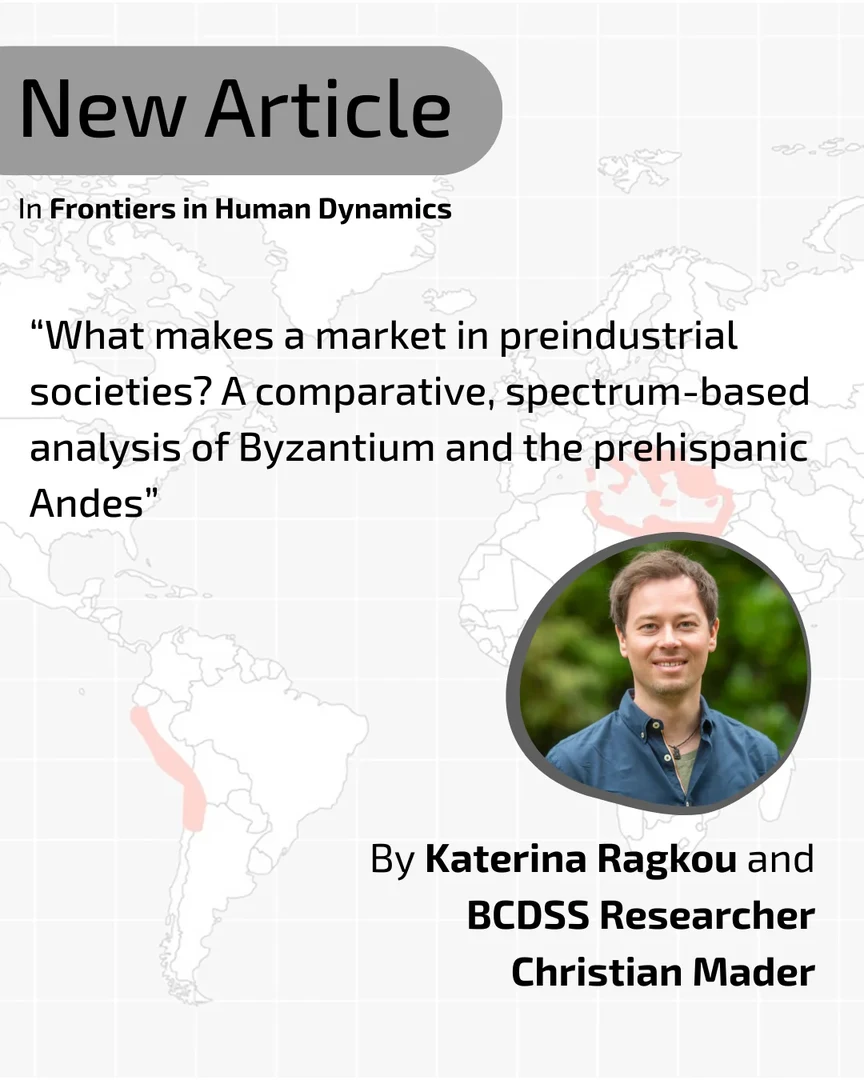
New Article by Christian Mader.png
© BCDSS
Download all images in original size
The impression in connection with the service is free, while the image specified author is mentioned.